Monday, 8 April 2019

Genocide killer turned 'prophet' led thousands of Rwandan prisoners to Christ and repentance

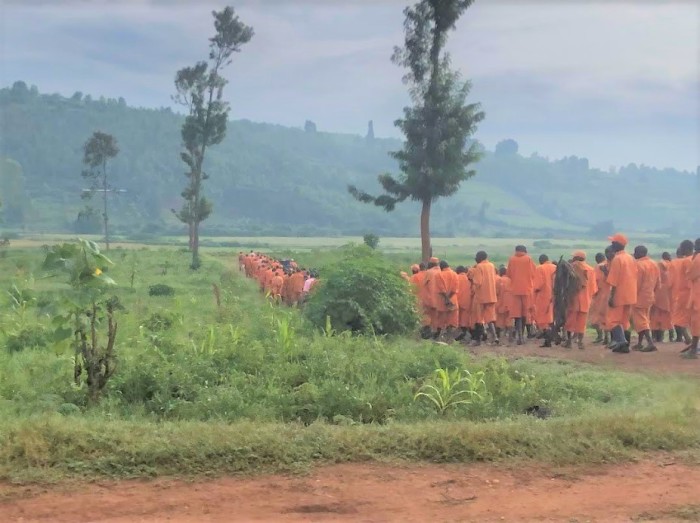
Prisoners prepare for manual labor in the fields of the Southern Province of Rwanda. | THE CHRISTIAN POST
SOUTHERN PROVINCE, Rwanda — Callixte Karemangingo was among the thousands of Rwandans incited by extremist propaganda and nefarious leaders in government to carry out one of the worst atrocities the world has ever seen.
But that was before he became a Christian and realized he had spiritual gifts.
During the Genocide against the Tutsi in 1994, Tutsis looking to keep their lives were told to go to certain locations where they believed they would be safe.
As countless Tutsis gathered at these locations (in many cases churches or places of worship), many of them turned out to be slaughter traps.
Despite being a predominantly Christian nation, over 800,000 Tutsis and moderate Hutus were killed in the span of three months, from April to July 1994, by enraged Hutus and military forces. Neighbors killed neighbors and Christians killed Christians.
Callixte, a Hutu cattle farmer living in the Nyamagabe district, was among the Hutus who led his Tutsi neighbors to a "safe" place in their community despite knowing that was the place where they'd be executed.
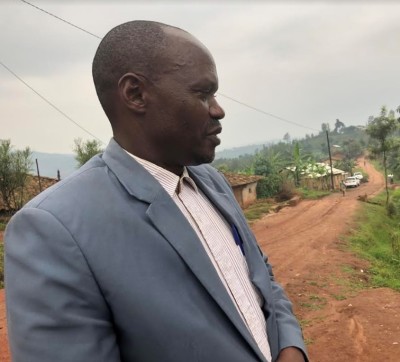
Callixte Karemangingo speaks with reporters in the Nyamagabe district of Rwanda's Southern Province in February 2019. | THE CHRISTIAN POST
Some of them were people he considered friends. But those relationships didn't stop him from leading them to certain death.
Why? Because there was hatred in his heart that was inspired by toxic extremism and government propaganda that led Callixte and tens of thousands of others to believe that Tutsis were the enemy of the Rwandan state.
But after the genocide ended and the rise of a new government, Callixte was sent to jail in May 1995. He was there along with thousands of other genocide perpetrators and even Hutus who had nothing to do with those crimes against humanity.
Spending five years in prison, Callixte eventually began a personal relationship with Christ.
"[I repented] on Feb. 8, 2000. That is when I had my revelation," Callixte told reporters who visited him, his wife, and their friends while on a trip with the humanitarian agency World Vision. "I had a voice telling me that the air is going to blow but the one who has repented of his sins from the bottom of his heart, that air will do nothing to him."
It was at that point that Callixte took his relationship with Christ to a new level. He was preached to and started reading the Bible on a consistent basis.
"That is when I started repenting of my sins, each and every sin. I mainly focused on the sin of participating in genocide," he said through a translator in his native tongue of Kinyarwanda.
"I was thinking about the Rwandans who were blamed for their tribe when they were not the ones guilty themselves. When I would think about it, I would just bust out and start crying."
Inspired by the word of God and the teachings of reconciliation and unity promoted by the Rwandan Patriotic Front, which rose to power following the genocide and end of the Rwandan Civil War, Callixte said he made the decision to live a godly life.
He said he knew that he should listen to the "good leadership" that rose to power in his country instead of the "bad leadership" that enabled the genocide to occur.

Songs of peace and reconciliation

As a musician, Callixte's change of heart inspired him to compose songs centered around love, unity, peace and reconciliation. He said he could prophesize through music.
"Those songs actually touched people's lives, mostly the prisoners, and they started to change their ways," he said. "When I started composing those songs, they started moving me [to different places] in other districts to sing those songs. I even went to the city to sing those songs."
Callixte also said he began preaching inside the overcrowded prison.
"I became a teacher of the community court within the prison. I could teach them about living with others," he explained. "I could always emphasize on the fact that God told me whoever asks for forgiveness, he would be forgiven."
At first, he said, his fellow prisoners were still influenced by the ideology that got them into prison and rejected his teachings. But eventually, he said, many prisoners started listening to him.
As a musician, Callixte got involved in different competitions where he sang songs and was even rewarded for it. Even though he was still a prisoner, he said the government allowed him to keep the money he earned from those competitions.
As he became a vocal leader among the prisoners, he said he helped lead at least 8,600 prisoners to repentance with many of them coming to know Christ.
"The number [8,600] is really small compared to the number of people that requested for forgiveness and were released because they told the truth," he said.
One of the main Bible passages Callixte would recite while preaching in the prisons was 1 Corinthians 1:1-30.
That passage calls for believers of Christ to be “perfectly united in mind and thought” — an idea that might have seemed far-fetched considering the ethnic tension that had existed in the country for at the time. 
Callixte's request for fellow prisoners to repent of their sins was aided by the fact that the Rwandan government had launched an initiative allowing perpetrators to seek forgiveness through local community "Gacaca" courts. 
The Gacaca initiative presented not only the opportunity for perpetrators to seek forgiveness of their crimes from their victims but also for community members to decide what a perpetrator's punishment should be.
This initiative was launched as there were too many cases for the nation's judiciary system to handle in a timely manner.
"Many people came to know Christ and confess their sins. I was preaching on two things: the Gacaca government directive and the word of God," Callixte recalled.  "So for me, asking for forgiveness was not that difficult."

An old friend turned bitter enemy
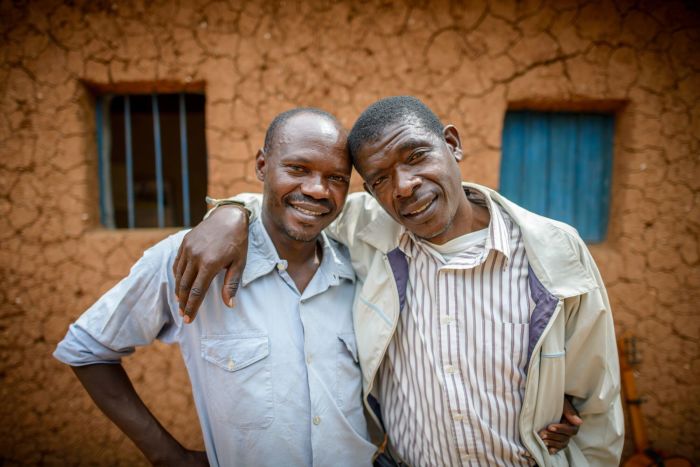
Callixte Karemangingo (L) and Andrew Birasa (R) | WORLD VISION
In the immediate years after the genocide, Callixte, his wife, Marcella, and their children had a deep resentment for their neighbors Andrew Birasa, his wife, Madrine, and their children.
Andrew, a Hutu coffee farmer who had known Callixte since they were young, was the person who implicated Callixte for his genocidal crimes, which created resentment between the two families. 
Andrew was good friends with Callixte when they were growing up. There was peace and harmony in the village until the ethnic tension came to a head in the 1990s. The division between Andrew and Callixte came over the fact that Andrew had married Madrine, a Tutsi.
During the genocide, Hutus who married Tutsis were also seen as enemies and were considered "Tutsi lovers."
In 1994, Callixte was part of a large group of genocide perpetrators in their community responsible for the death of Madrine's parents and other family members.
While Callixte was in prison, the two wives would not speak to each other, their kids would not play with each other and their livestock could not dare go onto each other's lands.
But that all changed thanks to the evangelical Christian humanitarian agency World Vision Rwanda, which provided relief and reconciliation efforts throughout the country and in their community. Starting their programs in 1994, World Vision today is the largest Humanitarian agency present in the tiny, landlocked central African nation.
The two wives began volunteering for World Vision and the charity encouraged the families to forgive and be forgiven.
As the genocide was one in which neighbors trespassed against neighbors, World Vision and the Rwandan government knew that forgiveness and reconciliation would be central components in building a united Rwanda. Without those components, that resentment that neighbors on different sides of the genocide had would hamper any recovery efforts.
In prison, Callixte heard about the work that his wife and Andrew's wife were doing together through World Vision and started learning about peace and reconciliation.
Callixte was taken to the Gacaca court. He confessed of his sin and asked for forgiveness from Andrew and his wife. He also asked for forgiveness from all Rwandans.
"They forgave me, but mostly Andrew and his wife," he explained. "They forgave me and they took me out of prison and they pardoned me."
Andrew told reporters that although it was tough to forgive a man that killed his wife’s family, his family’s heart started changing “slowly by slowly.”
“Together with our good leadership and their advice to citizens, all that helped us to be transformed and live with each other," Andrew explained. "Those training sessions at the Gacaca court made it possible for communities to come together and discuss those who had come to seek forgiveness and those who had been offended."
“Today, we are good friends and our wives are good friends," he added.  "Our children are good friends and there is a lot of love between the two families.”

Working together
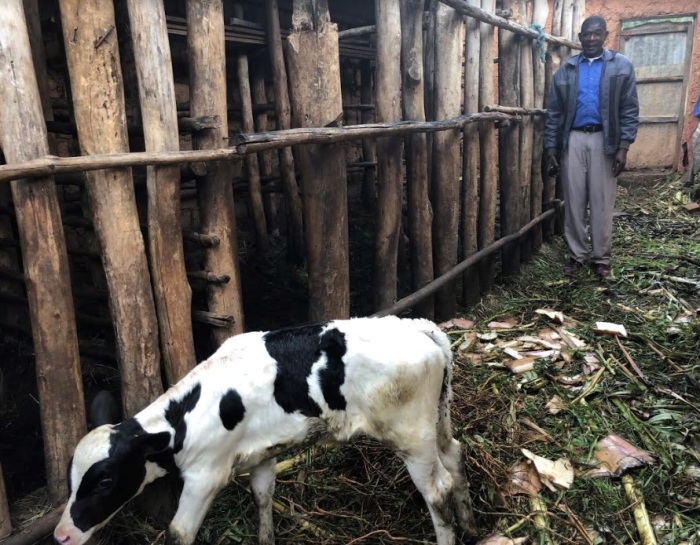
Andrew Birasa looks after a cow at his home in the Southern Province of Rwanda in February 2019. | THE CHRISTIAN POST
Having reconciled, Andrew and Callixte were able to discuss their feelings about what happened. Before going to prison, Callixte was quite good at making money by selling cattle.
To help make amends for his crimes, Callixte taught Andrew how to sell cattle.
"Now he does it even better than me," Callixte quipped. "We worked together in a way that is very good. What makes me happy is that my wife and his wife are so close. They share one heart."
Andrew also told Callixte about how World Vision enacted a program to hand out iron sheets to help provide homes with sturdy roofing. World Vision was also able to help Callixte build his house.
Additionally, Callixte and Andrew began working together when World Vision launched a project in which neighbors would have to combine plots to create bigger farms to grow coffee plants.
Through the program, groups of genocide perpetrators and survivors were given cows to create milk and fertilizer. The fertilizer would be used to grow coffee plants.
Andrew and Callixte were part of the same group responsible for harvesting the same coffee plants, forcing them to talk through the pain of what occurred years prior.

Two families become one
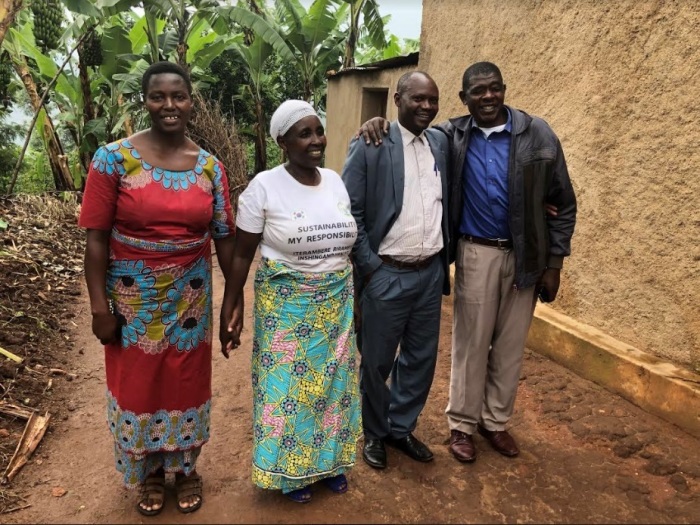
Callixte Karemangingo (middle right) and his wife, Marcella (left), pose for a photo with Andrew Birasa (right) and his wife, Madrine (middle left) at Birasa's home in the Nyamagabe district in Rwanda's Southern Province in February 2019. | THE CHRISTIAN POST
Andrew and Callixte's children saw the change in their parents’ relationships and also grew closer to one another.
Callixte's first-born son, Mizero Jean d'Amour (now 23), and Andrew's third-born, Chantal Irabaruta (now 22), grew insuperable.
As they went to school together, they would always try to sit next to each other in class.
"One would always be next to the other," Callixte explained. "They are so close that their love surpasses any love between a man and a woman."
Speaking with reporters in Andrew's home, the two couples were happy to announce that their children are planning to get married after they finish with college.
"For us, we are very happy with the fact that we both live together well as families and that people have come from far and wide to see us.
This meant that the two couples that used to be bitter enemies will one day become in-laws.
"As a family we support their plans and we would like to invite all of you to the wedding," Andrew told reporters. "We keep saying that it is God who did this. With [just] human strength, this would not have been possible at all."

Callixte's prophecy

Because of their story, World Vision invited both Andrew and Callixte a few years ago to travel to Chicago to share their experiences. They were both excited for the opportunity.
World Vision paid for Andrew and Callixte to stay in a hotel in the capital city of Kigali prior to their flight. But in Kigali, Callixte said he got a vision from the Holy Spirit telling him that he would not be able to go on the trip to Chicago.
He told Andrew about the vision and Andrew was not happy because he thought that meant that he would not be able to go as well. But Callixte assured Andrew that he would indeed go on the trip.
"When I kept praying, God would tell me that I am not going to go," Callixte explained.  "We kept on praying while at the hotel to see if God was OK with us going. When he got his Visa and I didn't get mine ... I was at peace because God told me that I wouldn't get to go."
Callixte additionally told Andrew that he bring a gift back for him. That is exactly what happened, the men say.
Andrew went on the trip and received two gifts. Andrew himself received a synthesizer. He was also given a new guitar to bring back to Callixte. The new guitar was much better than the one that Callixte had already owned.
"It helped Callixte improve and work on his music career," Andrew said.  "He is [now] invited to different places to play the guitar."
According to Callixte, many Rwandans believe that Christians musicians may also be prophets.
"I have both of those gifts. God gave me discernment,” Callixte said.  “I am sometimes able to see something before they occur. Sometimes I can do that for others as well and tell you about your prophecy."
Andrew told the journalists that he ended up giving the synthesizer to the local church in their village. He added that the synthesizer helped the church to grow.
"People became more and more interested with a musical instrument and even more people get saved," Andrew said.
The two families became a model for reconciliation and others wanted to learn from them and hear their story. 
"For us, we are very happy the fact that we both live together well as families and that people have come from far and wide to see us," Madrine, a mother to seven children, said.



Christians combat depression and suicide too; Pastors and ministers share how they get through

Photo: Getty Images/AngiePhotos
The depression rate worldwide is on a continual rise and Christians are not immune. With multiple headlines of pastors who died by suicide throughout the United States, The Christian Post decided to reach out to ministers to talk about how they combat their darkest moments.  
Throughout the years, several popular Christians have been vocal about their battles with depression and anxiety, from Charles Spurgeon to Perry Noble, and artists Mandisa and Lecrae.
Just last year, the suicide of Inland Hills Pastor Andrew Stoecklein shook the American Church after he admitted he was dealing with depression. An alarming number of pastors and Christian leaders have taken their own lives in the last five years.
Despite the increasing notice of depression and suicide nationally, the resources to help people in the church struggling with these thoughts or feelings are scarce.
According to the World Health Organization, depression at its worst leads to suicide and it affects 300 million people worldwide. It’s estimated that 15 percent of people will experience depression at some point in their adult lives.
A 2019 survey shows a diverse mix of countries with the highest suicide rates. Among the top four are: Lithuania, Russia, Guyana, and South Korea. The U.S. is No. 27 on the list. More people reportedly die of suicide than homicide in America.
Among young adults, the suicide rate for people 18 to 19 years old is up 56% from 2008-17. Depression among 20- to 21-year-olds doubled between 2009-17, and anxiety and hopelessness among 18- to 25-year-olds jumped 71% from 2008-17.
Reports show that more than 253 million prescriptions were written for antidepressants in the U.S. The percentage of those diagnosed with some form of distress jumps by 30% every year.
Christian pastors and music ministers offered advice and practical tools they use to combat the widespread outbreak of depression and anxiety.
Dealing with depression
Erwin McManus, pastor of Mosaic Church in Los Angeles, California, and author of the new book, The Way of The Warrior: An Ancient Path to Inner Peace, says firstly people need to realize that depression would be impossible if the one struggling couldn't imagine something greater.
“A huge part of the reason that we're depressed is actually because we can imagine a better life, a better self, a better world. What I tell people is, 'what happens when we get depressed is we give up on believing that we can step into the life that God has for us,'” McManus shared with The Christian Post.
The pastor explained that subtle lies try and consume individuals to the point that they become depressed because of the belief that the present moment is a “permanent moment.” It brings to mind the testimonies of all 29 people who survived jumping off San Francisco’s Golden Gate Bridge in hopes of self-destruction — they admitted that they regretted their decision as soon as they jumped.
"I have had to remind myself so many times what I'm feeling right now, what I'm going through right now, it's temporary, that there is a way out, there's a way forward and it's going to get better,” McManus said of his own efforts.
It isn't about changing one's circumstances but rather changing one's perspective because all people have the choice to engage with depression or oppose it.
"As hard as it is, one of the first steps to getting past depression is gratitude. Because when you're grateful you actually begin to see the good all around you. When you're grateful, you see the beautiful and it actually fills you with hope,” he added.
“When you're ungrateful, all you see is everything that's going wrong. And no matter how much someone does for you, it's never enough because when you're ungrateful your soul is like a black hole — it consumes all the light and only leaves darkness.”
Legendary contemporary Christian artist Steven Cutis Chapman knows all too well what suffering from depression is like. The singer lost his youngest daughter, Maria Sue Chapman, in a tragic car incident in front of their family home in 2008. And along with having to face the grief of it all, his wife, Mary Beth, has battled “chronic depression” for years and continues to struggle.
The Grammy Award-winning musician agrees that Christians should apply spiritual remedies and natural ones.  
"If you're battling with that, just like you would be battling with cancer or with diabetes or with any other illness, you pray for those, you pray the same. But there's some stigma that says, 'mental illness, you just need to pull yourself up and pray and trust God more.' I think just being truthful about the reality that we need a good therapist, we need a good psychiatrist, all of that,” Chapman told CP in a recent interview in which he also discussed his new album, Deeper Roots.
"God's a God of chemistry as much as He's a God of anything else. So medicine that can help people is important. I think all of those things are just important for us to address,” he said.
Bethel Music’s Amanda Lindsey Cook said she was able to find some relief for her life-long battle with anxiety, depression and self-confidence when she took some time away in a secluded cabin in the woods.
“I think in our information age and the culture that we have, where we have access to everything at our fingertips, it's really hard to scale down and to pare down to the bare necessities,” she lamented. “For me, it continues. It's not like one day you get there, and then you're like, 'I've arrived.' There's no such thing.”
In this silent season, Cook recorded her new album, House on a Hill.  
“For me, it was one of necessity, I had to go quiet. I needed space, I needed to think my own thoughts for a bit. I needed to find out what I actually thought about some things, what I believed about some things,” Cook said of her recent experience. “I needed to let things rise to the surface, which is what happens in silence, things tend to just arise in us.”
The young minister noted that people tend to run from the pain and hurt in their lives.
“The tendency can be to think that agitation is a problem. So we feed ourselves with the distraction, something different, something that takes our mind off of that thing that's arising. But it will just keep coming back around because it's actually part of healing; it's trying to heal itself.”
It’s important to note that while Cook took her sabbatical, she did have a strong support group of friends that she confided in and even created her new music with.
Pastor Ben Courson, who recently authored the book Optimisfits, stressed the importance of relationships.
“It is definitely easy for leaders to get lonely and withdraw. But it’s germane to our joy that we don’t retreat into ourselves,” the founder of Hope Generation said. “To safeguard against depression, it is imperative that we surround ourselves with friends. The motto of my life right now is: ‘adventures with God, adventures with squad.’ That’s the theme of Optimisfits. I know it’s easier to isolate than to infiltrate.”
Courson’s book was birthed out of his desire to rebel against hopelessness. He himself battled debilitating depression and even thought about suicide.
“We need leaders who are happy warriors, who fight for what we don’t feel, count it all joy, enterprise on an adventure of hope, and show the world that fun is fundamental!” he declared.
Authenticity is also fundamental to being free from oppression, Courson said.  
“It’s important to be real. As an artist once said, ‘I would rather be hated for who I am than loved for who I am not.’ I want to be who I am, live what I believe, and be a person of conviction rather than convenience."
“Fun side note: the word BELIEF comes from the Germanic origins meaning ‘BY LIFE.’ In other words, if we don’t show what we believe by the way we live our life, our minds will be in conflict rather than holistic. Honesty and authenticity is the pathway to peace.”
The importance of having a support system was also highlighted by Reach Records hip-hop artist and ministry leader KB. 
"One thing I’ll say is that I have a good pastor in my life, someone who I submit to. He has authority, and what he says to me matters," KB said while on the 2019 Unashamed Tour.
"It's not like a dictatorship, but I seriously consider every bit of counsel that he sends my way and I'm honest with him so I'm not asking him to counsel a version of myself that doesn't exist because I'm lying about where I am, and what I'm doing. I try to be open and honest about where I am and then allow him to speak in [to my life],” KB said about one of the ways he safeguards his own sanity.
The emcee stressed that being surrounded by good friends is an important dynamic in staying emotionally healthy.
“I'm using that word 'friends' synonymously with other disciples of Christ who are also walking and strengthening my arm in the battle,” KB maintained.
“Those are two things that have helped me not to lose my mind, that have helped me not to jump off the deep end. I guess it may appear to folks that I'm just strong or something but that's not it, I just got leaders around me and also friends.”
What could be causing the increase of depression and suicide?
Depression is running rampant in Gen Z and Gen Y with people dying by suicide once every 40 seconds. Courson believes there’s one major contributor as to why there are “123 suicides per day” in the U.S. 
“The data show this is partially due to social media," Courson said. "When we compare our behind the scenes with other people’s highlight reels and do so at unfair time intervals. We get swept up in a whirl of illusions. All that comparison steals our joy.”
The cure to social media grief is to “scroll less and live more,” he advised, without worrying about what others online are doing.
“When it comes to social media it would do us well to take it with a grain of salt and not get so worked up about it. We should take a whole lot more things a whole lot less seriously. After all, angels can fly because they take themselves lightly,” he quipped.
McManus echoed Courson and pointed to the pressure for young people to feel like they have to be perfect because mistakes now have the potential to go viral and ruin someone's life.
Another factor leading to being overwhelmed and anxious is the amount of information that people have access to, McManus suggested.
"I think the human spirit, our psychological construction, we're not really prepared to take endless amounts of the psychological barrage that we now have through massive information, social media,” he said. “I think you have 12 year olds who are handling the emotional weight that full-blown adults would never have experienced 100 years ago.
"The level of trauma and challenge and uncertainty is weighing so hard on our generation, on our culture, that 8 year olds are having to take on the emotional weight of things that you wouldn't even know if you were president.”
He maintained that the average American today has more information than a president did just 50 or 100 years ago.
"We're more aware of what's going on all over the world than any world leader during World War II. This is what children are dealing with, this is what 22 year olds are dealing with,” he lamented.
What can the church do to help?
Chapman believes people of faith have to get rid of the idea that depression is a “season” that people get over.
“That language sometimes sets us up as Christians to say, 'I better not talk about it until I have the victory.' And in the process, so many people are just being devastated by [depression].”
The popular singer/songwriter referenced poet and hymnodist William Cowper who wrote, “God moves in mysterious ways” and still suffered greatly.
"So many of these great people of the faith battled depression deeply, Cowper tried to take his life on several occasions but we don't hear those stories or at least I didn't grow up hearing those because you sing about the victory,” Chapman noted. “That sets us up, especially in the church, to not want to address mental illness because certainly, ‘you just need to pray more and be a better Christian.’ And well, from experience in my life, and my wife, and our journey, that's not God's heart for us to address it that way.”
He went on to mention the death of Pastor Rick and Kay Warren’s son to suicide in 2013. The Saddleback Church leaders lost their 27-year-old son due to his struggles with mental illness.
"It is a reality that in the church, if anybody ought to be being honest about it, and say, 'hey, yes, we pray, and we have to pray and trust God ultimately, but you realize that mental illness and the impact of that is so real and we need to be more and more honest about it. Look, we need to talk about it, we need to take the stigma away, as so many people feel in the church, especially,” Chapman insisted.
To those who have felt let down or misunderstood by the church, Courson wants them to know he has been there also, along with many of the world’s greats.
“Did you know Vincent Van Gogh was a preacher in a Belgian mining town? But the elders fired him because he gave away his possessions to the poor coal miners and lived homeless like Jesus,” Courson shared.  “He slept in a haystack behind a baker’s house and would show up to preach with hay sticking out of his clothes and smelling like bread. So the board of elders let him go.”
Van Gogh would go on to become one of the most influential painters in Western history.  The preacher said the popular painting “A Starry Night” features a church without the lights — “dark” because it turned its back on the artist.
“And yet, he gave billions a glimpse of God’s glory with his swirling stars and post-impressionist brilliance,” Courson said of the troubled painter who battled depression for the remainder of his life and is believed to have committed suicide.
“When churches don’t get you or close the door on you, God has not forgotten about you and like Vincent, He will use you to reach the disenfranchised,” Courson emphasized. “Our rejection is God’s protection.”
The Optimisfits (optimistic misfits) author hopes his book would help ignite a generation to a “fierce rebellion against hopelessness.”
“People say, ‘learn to live with depression.’ No thank you. We are called to defeat depression! We are called to follow our dreams, never present an image to the world that’s not who we are, grab hold of the promises of God, and embark on funventures! It is high time for the joyful soldiers to rise up against the despair wracking our culture, and to turn our mope generation into a hope generation!” Courson concluded.
If you or someone you know is struggling with depression or thoughts of suicide, contact the National Suicide Prevention Lifeline or get Christian resources at cru.org or theexitmovie.com.


What's the future of the Church as it loses favor in secular society?

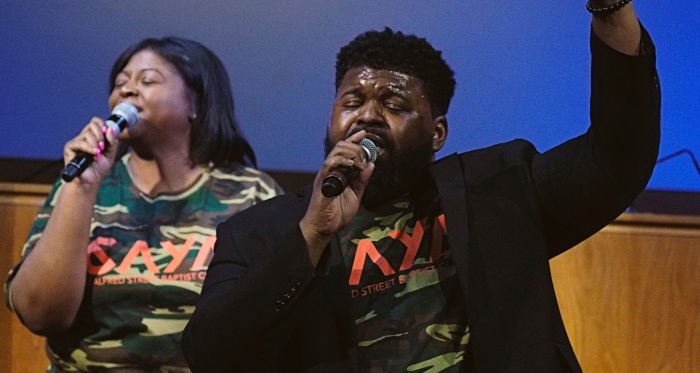
Worship team at Missio Alliance Awakenings Conference on March 29, 2019. | Photo: Justin Heap
ALEXANDRIA, Virginia — If the Western Church is to be effective in its mission as it loses favor in secular society, it's going to mean embracing peacemaking and remembering our role as a royal priesthood, speakers at Missio Alliance's Awakening Conference advised.
Theologians and pastors from around the country spoke about the future of the Western Church as Christianity loses its place of privilege in secular society that it held for centuries. The discussion was part of a panel at Alfred Street Baptist Church on March 29. 
Faced with the need for a new missional approach to engaging the culture, Al Tizon, a professor of missional and global leadership at North Park University in Chicago, Illinois, said he believes Christians must embrace peacemaking and reconciliation as a Gospel imperative.
"In our brokenness we have made a bloody mess of God's beautiful, diverse world," Tizon said, adding that the human condition is the same all around the world.
"I contend that in a world literally quaking and cracking along racial, ethnic and cultural fault lines, the Church must embrace peacemaking and reconciliation as the primary paradigm for mission today," he continued. "We can no longer relegate peacemaking to fringe pacifists and historic peace churches. Peacemaking needs to be central to the whole churches whole mission throughout the world."
He added that he wants the word "peace" to become as hip as justice has become.
Keesha Polonio, associate director of the Tampa Underground Network, stressed that it's vital for Christians to consider the image of the curtain in the temple being torn when Christ was crucified, particularly their role as priests.
"We need to remember that the veil was split in two and that now I, you, we can interact and engage with the Holy One. We have direct access," she said, referencing 1 Peter 2:9 in which Apostle Peter speaks of God's people being a royal priesthood.
"But I wonder if the Church has forgotten this?" she posited. "Will the Church give everyone an opportunity to live out their responsibility as a priest?"
That might mean for churches to give up their freedom to dream in order that the dreams of others can live, she suggested.
What this would look like, she said, would mean "we'd let the voices of the people we seek to serve to dictate our programs and our infrastructure and not the other way around. And don't let our fear and the risky nature of freedom constrict us and control us.
"We have to suspend the idea that our way is the right way. We have to give up our bent toward micromanaging" and instead release people to do what God has called them to do, she stressed.
In many respects the Church — and its insistence upon specific structures — needs to get out of the way, she said.
In Polonio's ministry, she said they try to see everyone as priests. Her "parish," she said, is in strip clubs as she ministers to women ensnared in the sex industry. On any given Friday when she gives altar calls it is to music blaring overhead, surrounded with the smells of drugs and alcohol.
"My sermons are small. And they start with makeup tutorials" she said, as people often ask her about her hair and what products she uses.
"But at the end, I get to remind them of the truth, in 1 John, that there is a God who sees them, who knows them and is calling them out of their darkness into a wonderful light.
Our missional future hinges on the Church remembering that the veil is torn, that we are all a priesthood of believers, a community of sent ones.
"We have simple ecclesiology," she said, "Worship, mission, and community. Wherever those three things come together, that is the church."
When everyday people realize that they are priests they are empowered to do whatever it is that God has called them to do and the church infrastructure supports to come alongside them, she said.
The Awakenings Conference was a three-day event that concluded March 30.

Friday, 1 March 2019

United Methodist Church upholds position against homosexuality, same-sex marriage

View of the stage during the United Methodist Church's special session General Conference inside the Dome at America's Center in St. Louis, Missouri on Sunday, Feb. 24, 2019. | United Methodist News Service/Kathleen Barry
The United Methodist Church will maintain its official position that homosexuality is contrary to Christian teaching, in a decision following days of contentious debate over the issue. 
For the past several years, the UMC has been embroiled in an emotional debate over whether to change its stance, as outlined in its Book of Discipline, labeling homosexuality “incompatible with Christian teaching.”
Delegates at the UMC special session of General Conference, representing all of the global denomination, voted Tuesday to reject a measure called the “One Church Plan,” which would have allowed regional bodies of the denomination to determine their position on homosexuality.
Instead, delegates approved the “Traditional Plan” in a vote of 438-384. The Plan maintains the denomination's stance against homosexuality, gay marriage, and the ordination of noncelibate homosexuals while promising to better enforce those rules. 
Mark Tooley, president of the theologically conservative Institute on Religion & Democracy in Washington, D.C., celebrated the vote result against the “One Church Plan” on Twitter.
“African, Filipino, Euro delegates crucial. They saved growing global church from plight of imploding USA Mainline Protestants. Thank you!” tweeted Tooley.
The Rev. Joe Harris presides over the legislative committee while the results of a vote approving the Traditional Plan as amended by 461-359 are displayed. The vote still needed to be approved by the plenary session on Feb. 26, the final day of the special session of the 2019 General Conference of The United Methodist Church in St. Louis, Missouri. | United Methodist News Service/Paul Jeffrey
At the 2016 General Conference, delegates passed a recommendation creating a "Commission on a Way Forward," which was meant to analyze the denomination's position on LGBT issues.
Made up of a theologically diverse group of UMC leaders, the commission sought to create suggested proposals aimed at ending the divisive debate and possibly avoid a schism.
In April 2017, the UMC Council of Bishops announced that there was going to be a special session of General Conference in St. Louis, Missouri, on Feb. 23–26.
"The purpose of this special session of the General Conference shall be limited to receiving and acting upon a report from the Council of Bishops based on the recommendations of the Commission on a Way Forward," explained the Bishops in anofficial letter.
The two major plans that the commission recommended that were among those considered by the UMC delegates were the “One Church Plan” and the “Traditional Plan.”  
The One Church Plan would allow regional bodies and congregations to determine their own stance on homosexuality. This plan was supported by a majority of the Council of Bishops.
The Traditional Plan would maintain the UMC’s position against homosexuality, while offering stricter enforcement and possibly a “gracious exit” for pro-LGBT congregations.
Supporters of full inclusion for LGBT persons in the life of The United Methodist Church demonstrate in the observer's area at the UMC special session of General Conference in St. Louis, Missouri on Monday, Feb. 25, 2019. | United Methodist News Service/Paul Jeffrey
During the special session, while the delegates voted Monday to advance the Traditional Plan to a plenary vote, the One Church Plan and a pro-LGBT “Simple Plan” were both voted down. The One Church Plan was still submitted in a minority report. 
On Tuesday, delegates voted to reject substituting the minority report in a vote of 374 in favor to 449 against, effectively killing the One Church Plan.
Many delegates offered their opinions on the floor as to which plan they preferred. Ble Leon Nathan Ake of Cote D’Ivoire argued in favor of the Traditional Plan.
“The Bible tells us that we need to stay faithful to the Word,” he said through an interpreter. “It’s God’s plan, it’s the will of God, it is the biblical way.”
J.J. Warren of the Upper New York Conference, an openly homosexual delegate, passionately spoke against the Traditional Plan.
“Jesus told the little children to come when the disciples tried to shoo them away,” said Warren on the floor Tuesday. “Don’t shoo us away. Let us come.”
Adam Hamilton, lead pastor of the Church of the Resurrection in Leawood, Kansas, which is the largest United Methodist congregation in the United States, spoke against the Traditional Plan, calling it “regressive” and alienating to “centrists and progressives.”
“You’ve inspired an awful lot of people who are not really engaged in the struggle before,” said Hamilton to Traditional Plan supporters, garnering applause and cheers. “You’ve inspired them to action. They’re mad, they’re upset, they’re hurt.”
Even after the One Church Plan was voted down, hours were spent debating various amendments to the Traditional Plan proposal. 
From there, several "points of order" were entertained, many brought by individuals who expressed opposition to the Traditional Plan.

60,000 Christians gather in Orlando for 'Jesus Movement' of this generation

ORLANDO – 60,000 Christians from across the United States gathered Saturday to be part of a "new Jesus movement." 
"The Send," was a 10-hour event organized by Youth With A Mission, Christ for All Nations, and Lou Engle of Lou Engle Ministries. The Orlando, Florida event at Camping World Stadium featured several collaborators from various national ministries who hoped to motivate Christians to fulfill their God-given call.
According to Engle, the live-streamed event was inspired by a conversation in 2011 with YWAM members hoping missionaries would rise up following the death of Rev. Billy Graham.
As the day went on, The Send featured pastors and evangelists such Bill Johnson, Daniel Kolenda and Francis Chan, along with worship teams such as Hillsong Young & Free, Jesus Culture, Tasha Cobbs-Leonard and Bethel Music.
While at The Send 2019, The Christian Post caught up with two of the events collaborators, former professional ice hockey player turned evangelist Todd White and evangelist and founder of Jesus Image, Michael Koulianos. Below is an edited transcript of their reaction to the revival.
Christian Post: What is The Send?
Koulianos: The send is ultimately a war on inaction. It's to me a twofold beautiful experience. Number one, we're gathering here to be in the presence of Jesus to truly encounter Him and then be sent from His presence, to take His actual person, to our cities, to our towns, to our neighborhoods, to our families, to our marriages. Some to the mission field and some to their own workplace. The Send is an ascending movement from the presence to the world, unto the glory of Jesus.
CP: There are thousands of people gathered here worshiping Jesus what’s your reaction?
White: I think it's amazing. It's God's waking up a sleeping giant, His church to come together and being in unity of faith and not say, "I prefer my ministry before yours" but we actually prefer each other. What we've done is a collaboration of ministries coming together saying, "Let's all go forward in one purpose, one mind, and let's go purpose, Jesus everywhere we go."
Koulianos: I think if we tried this a year ago it probably would not have worked, we just think it's the Holy Spirit. Before anybody knew who we were, we were all friends and it's God knitting hearts very authentically because of common passion and love for Jesus.
It's the Holy Spirit moving and our city has been buzzing. People are getting saved on the streets, they're getting healed on the streets. The pre-rally meetings were ridiculous. It's been an amazing, amazing time and a real privilege. I told Todd this morning, "There's 7 billion people on the earth and the fact that we get to be here today is a true honor and privilege."
CP:  Lou Engle said he wishes to usher in the Jesus movement of this generation, what has shifted in the atmosphere that makes you believe that time for the next great awakening is now?
Koulianos: I think ultimately it's the Holy Spirit, first and foremost, but He works with yielded hearts and you find out very quickly, that platforms don't satisfy you, people knowing your name doesn't satisfy you, money doesn't satisfy, these things aren't intrinsically bad, but ultimately it's about Jesus and it's unto Jesus.
I feel like the Lord is birthing this Jesus movement and a Jesus people on and off the platform, in their homes. It's what He burns for.
White: I have new words, This is God! It's amazing, we started doing schools 12 years ago and 30 or 40 people would show up because we had to go do outreach, and hardly no one would sign up.
You don't have to be an evangelist you just have to be a Christian. So now we're seeing thousands and we're watching this, and over time we are seeing people just start to live up to what God's created them to be. There's such a hunger, there's such a hunger here in this place and it's drawing on Heaven and right now it's just going to build.
Video Player
Todd White and Michael Koulianos discuss The Send
According to The Send’s website, the successful event was “a call to action, a call to repentance and a call to service.”
Yassirie Moreno at The Send 2019, Orlando, FL, Feb 23, 2019. | assirie Moreno
Event attendee and ministry leader in her local Orlando church, Yassirie Moreno testified that The Send did exactly what it set out to do.
“I definitely felt it was a call to action, for sure. The most significant thing about the event to me was that it was obvious, it wasn’t about the people on the stage but the people in the crowd. There was a singular purpose that was felt, and it was to seek Jesus and worship Him,” Moreno told CP of the event.
The worshiper said she could feel the Lord's presence in the crowd as everyone collectively “served each other by praying for one another unprompted.”
Moreno added, “The atmosphere that was set simply allowed us to move in that and empowered us to want to see God’s power manifest outside of the stadium. It was like charging up your spiritual battery to go out and be the gospel for the community and serve with the heart of God. I can honestly say it was so much more than I expected. This event wasn’t hype, which I truthfully expected, but it was definitely a call to action and to live Holy, as Todd White said, ‘Grace isn’t a pass for us to sin but the power for us to live the way Jesus did, without sin.'”
To view the event, visit bethel.tv/thesend.

Myanmar pastor killed after being kidnapped at gunpoint, leaves behind wife and 3 kids

Slain Myanmar Pastor Tun Nu poses for a picture with his wife and three children in this undated photograph. | GFA.ORG
A pastor in Myanmar who led multiple fellowships is confirmed dead after being kidnapped from his home at gunpoint last month, the nonprofit mission organization Gospel for Asia has confirmed.
Pastor Tun Nu, who was one of GFA’s missionary field partners in the Rakhine state, was confirmed to have been killed along with others who were abducted by a faction believed to be a rebel army, according to a press release from the nonprofit. His death was reported on Feb. 1.
The 41-year-old Tun pastored a congregation of about 50 members in the Sittwe District of the southwestern Rakhine state, which is known for being torn by the Rohingya conflict and Rohingya genocide committed by Myanmar military forces in 2017.
According to GFA, Tun served as a pastor in Myanmar for two decades and is one of the hundreds of people to come to Christ and establish churches in that region. Since coming to Christ, Tun was believed to disciple 12 different fellowships of believers in the area.
Pastor Tun Nu was killed after being abducted by gunmen on Jan. 19, 2019, in the Rakhine state of Myanmar. | GFA.ORG
GFA reports that on Jan. 19, Nu was taken from his home by five men who reportedly told him that they just wanted to question him.
The pastor leaves behind a wife and three children.
“We are heartbroken to learn of Pastor Tun’s death, and we ask you to join us in praying for his wife, family and church at this time, that they may know God’s comfort, peace and strength,” said GFA founder and director KP Yohannan.
According to GFA, Pastor Nu’s death and kidnapping are the first incident of this kind to happen to a GFA-supported ministry in Myanmar. GFA is affiliated with over 500 congregations in the country.  
“All of the brothers and sisters on the field know that, as Jesus said, they go out as ‘sheep among wolves,’” Yohannan explained. “Like Pastor Tun, they are willing to lay down their lives, if need be, to share God’s great love with those who have not yet heard the Good News.”
Since the news of Pastor Nu’s death, GFA-supported church across Myanmar have taken up an offering to support Pastor Tun’s family.
According to U.S.-based nonprofit International Christian Concern, local police and government forces were not able to locate the pastor’s whereabouts during the two weeks that he was missing. GFA reported late last month that they had not received any requests for money or ransom.
A local pastor who chose to remain anonymous told ICC that people in the district were “too scared” to look for the Tun. The pastor asserted that the community did not receive “any help in searching for him.”
ICC Regional Manager Gina Goh called on authorities in Myanmar to hold Tun’s killers accountable.
“Our hearts sank at the devastating news of Pastor Tun Nu’s death,” Goh said in a statement. “We urge the authorities to investigate and bring to justice the perpetrators who think they can get away even if they shed the blood of the innocent. Our heartfelt prayers go out to Pastor Tun Nu’s loved ones, especially to his wife and three young children.”    
Violence continues to mar the Rakhine state as insurgents continue the push for greater autonomy for ethnic Buddhists in the region.
“The continuous savage attacks on the Rakhine state are heartbreaking," said Bob Roberts, co-chair of Faith Coalition to Stop Genocide in Burma, in a statement to CP."Last June, I spent 10 days in Burma’s Kachin state, in which about 95 percent of the occupants are Christian. Our brothers and sisters cannot keep suffering at the hands of these thugs. Kachin and Rohingya people need to be repatriated to their country and villages with full rights.”
In early January, a Rakhine Buddhist rebel group killed 13 police officers and injured nine others in attacks on four police posts. Later in the month, security forces returned the favor in a counterattack that killed 13 ethnic fighters.

China hearing gospel via Africa; church growing amid brutal persecution

A new system installed din at least 16 16 cities, municipalities, and provinces across China could pick out a face from a crowd with 99.8% accuracy, according to Chinese state media. https://pixabay.com/en/shanghai-old-town-renmin-road-crowd-565378/ | Pixabay/moerschy
As the Chinese economically invest in and build infrastructure in Africa, Africans are evangelizing the Chinese.
In 2014, trade between China and Africa reached an all-time high in 2014, according to the China Africa Research Initiative at Johns Hopkins University and McKinsey & Company. Billions of dollars in loans from China to Africa in addition to foreign direct investment have increased significantly in recent years.
Meanwhile, as a result of the influx of Chinese resources and approximately 10,000 Chinese-owned companies, the estimated 227,000 to 1 million Chinese working on the continent are hearing the message of the Gospel from African evangelical Christians.
"Many local African churches have reached out to Chinese workers, including incorporating Mandarin into services. A number of Chinese, in turn, have welcomed the sense of community and belonging that these Christian churches offer," according to UnHerd Wednesday.
"And a small but growing number of ethnically Chinese missionaries from Taiwan and other countries are specifically targeting Chinese nationals in Africa, preaching to them with a freedom they’d never be allowed in the People’s Republic."
This connection to the Gospel presents a challenge to the Chinese government which has a long history of brutally persecuting Christians under Communist dictator Mao Zedong, oppression that has been reinvigorated today as crackdowns on churches are occurring again. The government has blown some of them up and has arrested whole congregations. The government hostility to religion extends beyond Christianity and its activities; the Uighur Muslims have been detained and abused in Chinese government-run camps, according to reports.
Some outside groups estimate that between 25 to 50 percent of the Chinese population are believers in some kind of religion, to the chagrin of the government.
When those evangelized Chinese Christians return home from Africa, they bring their new faith with them.
"Visitors to the coastal province of Fujian, for example, now hear South African accented English and see houses adorned with crosses. African migrants are also moving to China in larger numbers, many of them practitioners of very evangelistic forms of Pentecostal Christianity who are willing to flout the rules placed on religious activity in China," UnHerd reported.
"Despite its best efforts, China is losing its fight against Christianity, and the growing influx of citizens returning from Africa is shaping up to be another hopeless front in that war."
If U.S. State Department figures are any indication, the number of Christians in China is approximately 70 million. Should current growth rates continue apace, the nation will soon have more Christians than any other country in the world.
Last year, as The Christian Post noted, an official believed to be behind the forcible removal of 1,700 crosses from churches in eastern China was promoted by the Communist government, amid concerns it was a sign of increased of state-sponsored hostility.
ChinaAid President Bob Fu said in a previous interview with CP that "the top leadership is increasingly worried about the rapid growth of the Christian faith and their public presence, and their social influence. It is a political fear for the Communist Party, as the number of Christians in the country far outnumber the members of the party."